
Trump's Trans-formational Triumph
A moment for humble reflection

The outcome
Obviously, not the result I wished for. But — also obviously — the voters of this country weren’t single-issue. Or, at least, not *my* single issue. For a large swath of the electorate, the economy was number one — and the Biden-Harris administration was seen as a failure (as evidence by Biden’s personal disapproval approaching close to 60 percent). Looked at in pure basics, one could be surprised at that — low unemployment, rising wages, jobs plentiful (despite a weak October report the Friday before the election). But inflation was, as it has been historically, was the government-killer. The global inflation that surged post-pandemic claimed yet another pandemic-era ruling party. As it did Germany’s Christian Democrats (2021), the UK’s Tories (2024), France’s Macron-ites (2024), Italy’s Draghi government (2022), etc. Ironically, had Trump won in 2020, Democrats would have been charging back into office right now.
As discussed on X-Twitter, in hindsight perhaps Democrats would have been better served had the red wave actually hit in 2022. The party would have had a real debate over the efficacy of continuing to be “ridin’ with Biden.” Perhaps there would have been a real primary that would have revealed that the incumbent didn’t have the physical constitutional chops to continue; perhaps, Democrats would have been willing to challenge Biden over his poor handling of the border. Or perhaps Biden would see the writing on the wall and opted to go the LBJ route and stepped aside. That would have sparked a true open primary with Kamala Harris either emerging a stronger general election candidate after emerging from a crowded field — or another candidate leading the party without Biden’s electoral baggage.
But enough of the woulda, coulda, shoulda. It is just a fact of life that inflation is one of the few economic realities that impacts everybody regardless of their economic status. It hits working class folks hardest the most because groceries take up so much of their disposable income. Inflation becomes a major hangover. Even when the actual rate starts to come down, the higher prices stay the same and people have to suddenly make triage on their spending. It also hits younger families looking to buy a home and finding interest rates too high. The inflation hangover is a beast, as Sean Trende well articulates. That’s the big issue that Kamala Harris couldn’t overcome, though, in hindsight there were other strategic and tactical errors of her own.
The Democrats’ problem
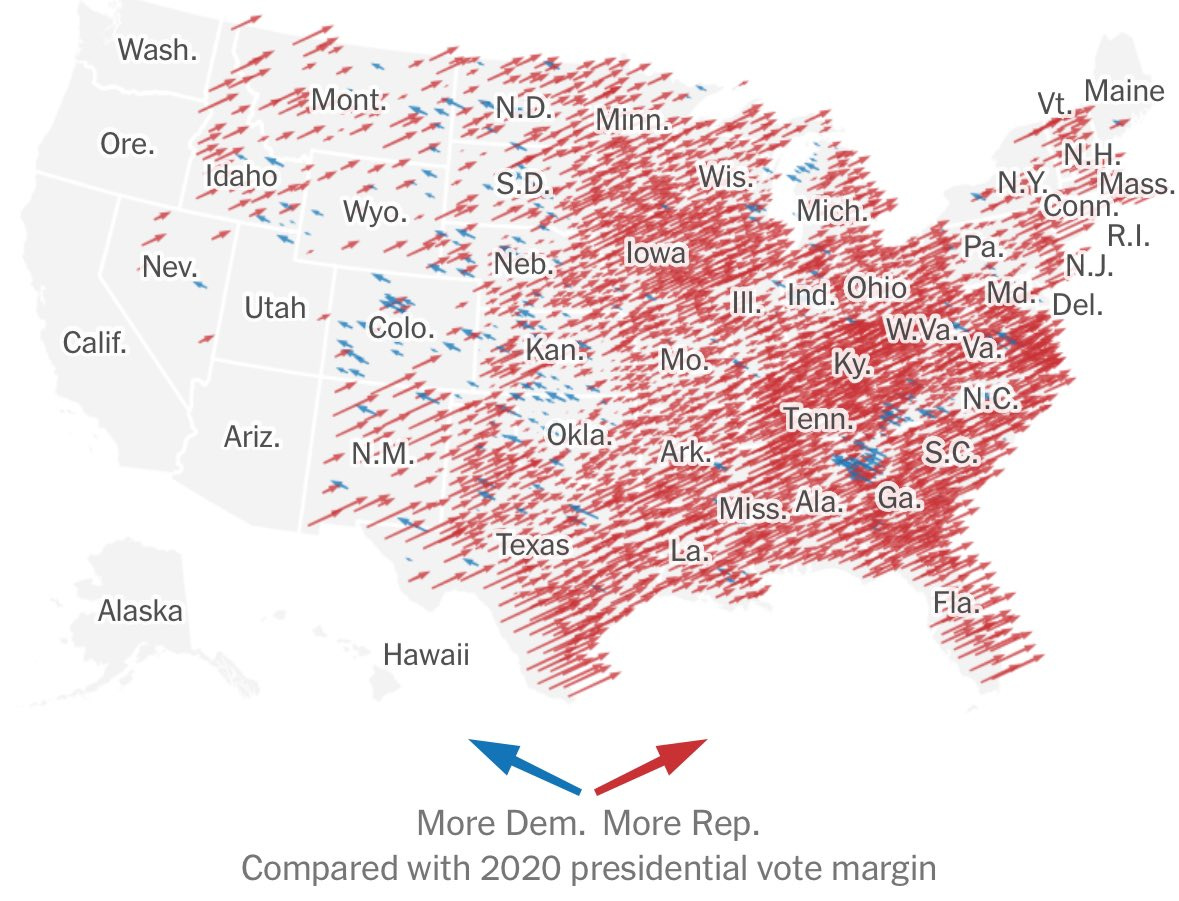
First though, one should address the cultural elephant in the room: Democrats as a party were rejected. Harris underperformed Biden everywhere, not just in the swing states. Blue strongholds like New York, New Jersey and Northern Virginia showed clear swings to the right. Trump had the strongest Republican presidential showing in New York City in 30 years.
In the last couple of weeks, two episodes provided me with hints of how things might go. I was in a Brooklyn diner in Park Slope — a very progressive area. The co-owner is an Italian-American in his late 20s-early 30s. He was settling an African-American customer’s to-go order. I came up with my check. While not hearing the beginning of their conversation, it was very clear that they were talking about transgender issues. The owner said something along the lines of, “Well I’m fine with people living as they wish and doing what they want, but don’t bring the kids into it, don’t include kids.” The customer nods his head and says, “Yeah, yeah, absolutely.” A week or so after that, I’m in a bar mid-afternoon and these two white guys sit down next to me. I was on my phone perusing social media and paying little attention to them. Suddenly I took notice of their conversation. They’re both in their 30s or early 40s, working-class guys. One was an electrician and they were talking about the Trump transgender ads they’d seen on TV. Now, these were very much anti-Trump guys. One of them (Roy), unbidden, spouted off about the times Trump had stiffed contractors in the city. But they were clear in their recognition that this issue was one that Democrats should deal with because it was gonna hit hard. These guys were from Long Island — part of the conservative suburbs of New York City. They know their neighbors.
These anecdotes together, in hindsight, made me realize that the transgender ad had broken through everywhere — as well it should have because the campaign ran it something like 30,000 times. It was placed during college and NFL games — some of the highest rated programs every week. The tagline, “She’s for they/them; he’s for you” was deviously brilliant. It works obviously at the basic level about trans policy — administrators allowing transwomen to compete against cisgender women — but it’s also applicable in a broader cultural sense where Trump comes across as being a defender of the cultural Visigoths. Criminal immigrants crossing the border? Yep. Bureaucrats that approved lockdowns? Sure. Teachers unions who kept the schools closed? Absolutely. The tagline hits people in their lizard brains —and, notably, with the exception of the Fox News interview, there was no real pushback from the Harris campaign — even as her own words were used to defend certain trans policy. On Fox, she (accurately) said the trans care prison policy was approved by the Trump DOJ, a technical response that doesn’t address the emotional gut-punch of the full ad. There was no concerted or focused advertising push against a really devastating ad that at its root cast Democrats as champions of an uncaring elite and Kamala Harris as their leader.
Harris’ missteps
This feeds into the broader problem the Harris campaign had after its initial energetic money-raising six-week launch. Harris’ decision to avoid media interviews early on was a mistake. At the end of the day, voters didn’t know what she stood for and how she would govern differently from Biden. The lack of more media interaction left her finding it difficult to answer simple questions such as “Identify a character flaw.” She needed to do that early and unfortunately did not. Love ‘em or hate ‘em, Trump and (especially) Vance entered friendly AND hostile territory and enjoyed mixing it up with all comers.
After the first few weeks of getting the campaign up and running, she should have sat down early with a friendly format where they could’ve asked her questions over her life and career and how her views evolved. Follow that with a full press conference, then go on more discrete interviews. Candidates get better as they engage more and more in campaign settings — that usually happens in a primary. Absent that, Harris should have gone more with the media engagement, rather than both, making her look like she was running scared and not using these settings as exercise to make her a stronger candidate.
Related to both Harris campaign strategy and Democratic elitism, is the role of Barack Obama as a closing days surrogate. Obama was incredibly successful as a candidate in 2008 and 2012. But he’s been out of office now for eight years. He’s become very successful as an author, documentary maker, podcast host with Bruce Springsteen and such. He’s now not exactly the best person to be telling Black men that they should get over their sexism and vote for Harris. That, of course, was based on arguably the biggest con of the campaign — polls suggesting that Black men especially were flocking to Trump campaign. Even if it were true — and the most wildly optimistic polls suggest Trump might hit the mid-20s with Black men — that would still mean that 75% of Black men were still supporting the Democratic candidate.
That’s a level of support that any party would praise the heavens for getting. Only African-Americans are subject to the arrogant notion that anything short of 100% support for a party’s agenda or candidate is considered some form of betrayal.
By the way, actual exit polls from Election Day shows Trump’s Black support at 12% — the same as 2020. Black men? It soared from 19% to…20%. So, Obama had to lecture the brothers over absolutely nothing (except, perhaps, on turnout — which was down, part of a catastrophic drop in Democratic votes from 2020)?
Word of advice to Democrats: If your electoral fortunes depend on near 100% support from one ethnic/racial group, the problem isn’t with that group’s outliers.
Trump’s cultural resurrection
I’ve made quite clear my dislike of Donald Trump, but one must respect reality staring them in the face. He’s dominated the political landscape for a decade — remarkable for any era in American history. To see one person having such control of a political party, one has to look to FDR’s four wins in from 1932-1944. Before that, William Jennings Bryan headed three out of four Democratic tickets in the 1880s and ‘90s (all losses). Not since Grover Cleveland has a president lost re-election, only to win again the next time around.
What has been most underestimated about Trump — by both political opponents and the media — is that, unlike the average politician, he conquered the American cultural landscape before moving into the political space. One reason why he managed to withstand often legitimate charges of racism and sexism is he was seen as a cultural figure both part of and above the day to day political fray.
Trump arose out of the New York real estate environment, “wrote” a book that became a bestseller nearly 40 years ago. He became a fixture on New York tabloids, popped up on shows like Lifestyles of the Rich and Famous, cameod in movies like Home Alone 2 and things. In the 90s onward — despite legitimate charges of racism due to the Trump Company not renting to blacks and his running an ad calling for the Central Park 5 to be executed (they were later fully exonerated) — he’s one of the most name-checked celebrities in all of hip-hop. Avatar of ostentatious wealth and being a player, he had substantial Black support. Similarly, by the 2000s, he began drawing more white male following by teaming up with professional wrestling. That combination partly explains his appeal to Gen X youth. Add in The Apprentice and you have a sense of the cultural alchemy that has allowed Donald Trump to dominate a decade in politics in a way no other politician in recent memory has.
In that time, he has ended political dynasties named Bush, Clinton and now Cheney (possibly the Pennsylvania Caseys too). He has fully transformed the Republican Party in his image. Beyond that, as the MSG rally the week before the election demonstrated one can say that he’s also done something that conservatives have strived for for decades — created an alternative to the popular culture dominated by progressive Hollywood. Unlike in years past, alt-popular culture stars — be they MMA executives, comedians, podcast hosts or others — they aren’t afraid to “live openly” as right-wingers (or anti-left-wingers).
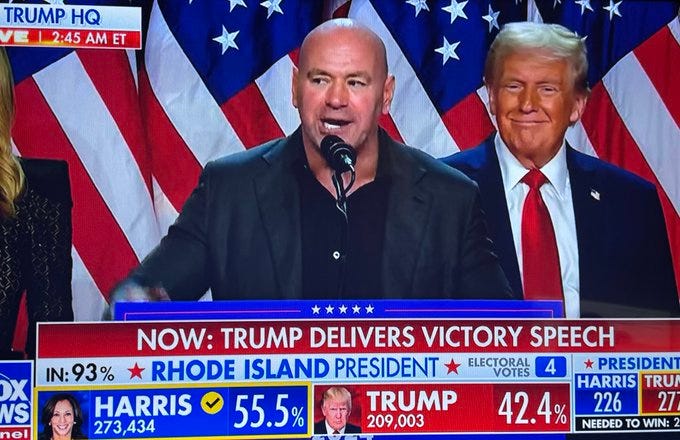
And, like Jason, he’s back — soon to be back in the White House.
I don’t like it. I think Trump will ultimately be disastrous for the country and possibly the world. But the people have made their choice. Unlike the 45th and 47th president, those of us in the coalition opposing him respect that choice and don’t cry “rigged”! We mourn the loss, move on and do our best to minimize the potential damage to the nation we love.
What must not be done, however, is continue doing what’s been done since Donald Trump first took that escalator trip into the American political consciousness in 2015.
That is underestimate Donald Trump.
Thanks, Robert. Well done
Voters didn't know what she stands for? SHE doesn't know what she stands for.
She's as transparent as a used-up, cheap windowpane...a prostitute and a fraud.