
From Holland to Homer
Christopher Nolan’s The Odyssey leads a generation raised on superheroes back to the original epic.

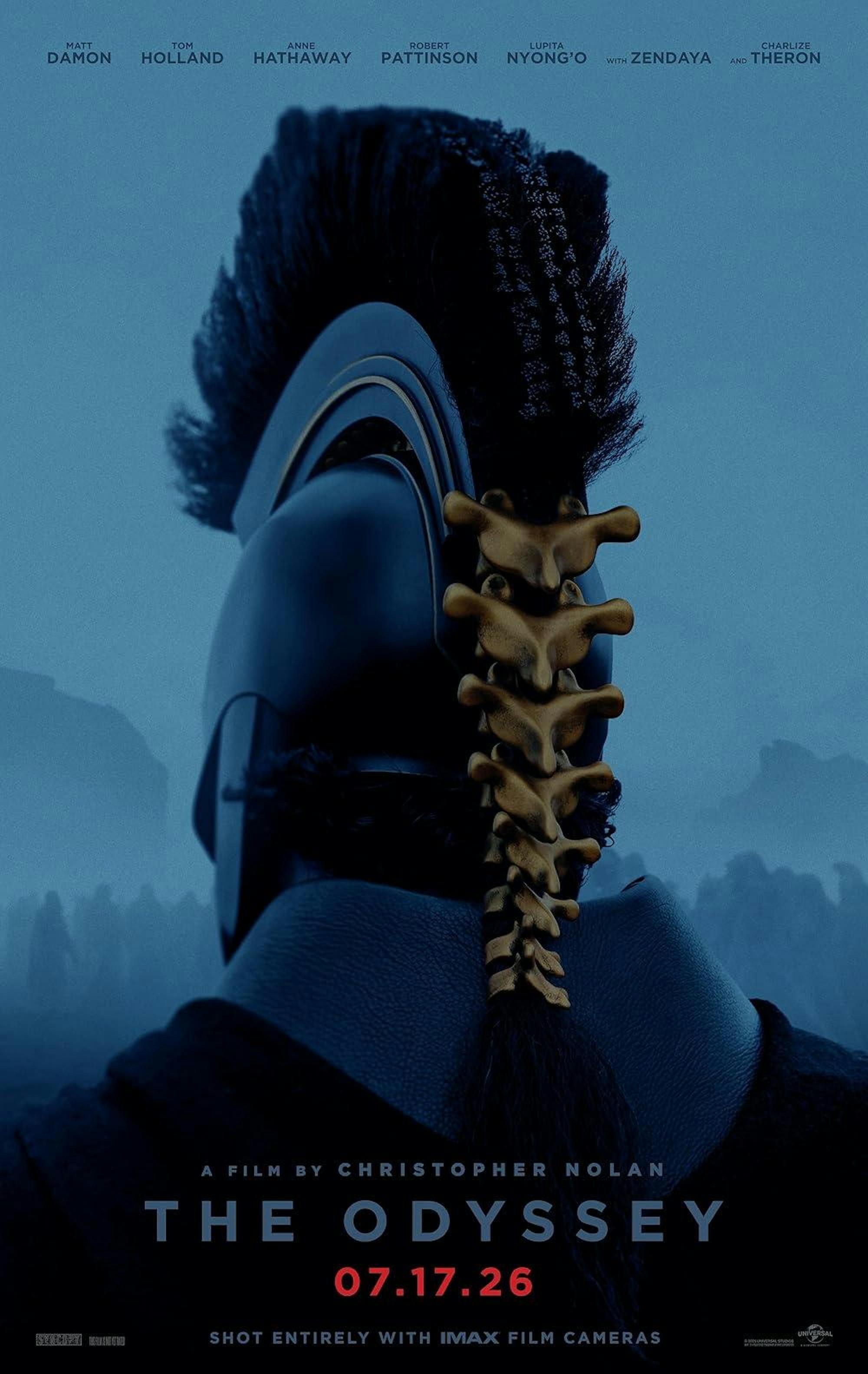
Leave it to the internet to spend weeks arguing about the least interesting aspect of Christopher Nolan’s adaptation of The Odyssey.
Much of the online debate has centered on the casting of Lupita Nyong’o as Helen of Troy and the brief appearance of transgender actor Elliott Page. Predictably, social media erupted into another round of accusations about “wokeness,” historical authenticity, and Hollywood politics. Many of the loudest voices on the political right have seized on those comparatively minor casting decisions as though they define the entire production.
In doing so, they’ve missed the forest for the trees.
The genuinely remarkable casting choice isn’t found in the physiology of those supporting roles at all. It’s hiding in plain sight across Nolan’s principal cast. He didn’t merely assemble a roster of A-list actors. Arguably, he deliberately recruited many of the defining faces of the superhero era to tell the foundational story from which virtually every superhero narrative descends. That’s a far more interesting—and far more consequential—creative decision than another predictable internet blowup over identity politics.
That idea resonates with me for reasons that go back much farther than Christopher Nolan — or even Batman.
Like many teenage boys, I was obsessed with superheroes. Batman, Spider-Man, Superman, The Avengers, Justice League — you name it. Comic books weren’t simply entertainment. They were worlds populated by larger-than-life figures wrestling with impossible choices, extraordinary powers, and timeless moral dilemmas. Before long, that fascination led me somewhere unexpected. I began reading Greek mythology — not because a teacher assigned it, but because I noticed something familiar. Hercules, Achilles, Odysseus, Perseus, even the gods themselves possessed similar qualities that drew me to superheroes. They were extraordinary beings confronting universal questions about courage, sacrifice, pride, and destiny. (Coincidentally, that ‘70s/‘80s era of comic books in which I grew up is known within the hobby as the Bronze Age.)
One summer during high school, I picked up Homer’s Iliad. I don’t remember which translation it was, only that it was prose rather than verse. Whatever edition I found, it worked. The book captivated me. Years later, while applying to St. John’s College in Maryland (the Great Books program), I wrote one of my admissions essays about The Iliad. Don’t ask the exact passages I analyzed (perhaps it concerned glory, heroism, or the uneasy relationship between mortals and the gods); nonetheless, I vividly remember realizing that Homer wasn’t telling an ancient story so much as the original story. Nearly every superhero comic I’d ever loved asked many of the same questions. What makes someone heroic? What does honor demand? Can greatness exist without tragedy? Those questions haven’t changed in nearly three thousand years.
Only the costumes have.
Which brings us back to Christopher Nolan.
At first glance, it’s easy to dismiss the casting of The Odyssey as the inevitable consequence of twenty years of superhero dominance. Nearly every major actor has appeared in a Marvel or DC film somewhere along the way. But Nolan’s choices don’t look accidental.
Tom Holland isn’t simply an actor who has played Spider-Man; for an entire generation, he is Spider-Man. Robert Pattinson is the current Batman. Anne Hathaway was Catwoman in Nolan’s own The Dark Knight Rises. Jon Bernthal is inseparable from The Punisher. Lupita Nyong’o helped define the Black Panther universe, while Zendaya is both Spider-Man’s love interest even as she’s a central character in a separate mythos, Dune. Even Matt Damon occupies a similar cultural space: Jason Bourne isn’t technically a superhero, but he is one of modern cinema’s defining larger-than-life tortured action heroes.
Viewed individually, each casting choice is understandable. Viewed together, they begin to look remarkably intentional.
There’s another layer of irony here that makes Nolan’s approach even more fascinating.
For decades, actors approached comic-book movies with caution and trepidation. The fear wasn’t that the films were beneath them. It was that they would become trapped by them. Playing Batman or Spider-Man might make an actor a household name, but would audiences ever see that performer as anything else? Being typecast was reportedly the primary reason ‘50s TV Superman George Reeves eventually took his own life. Years later Adam West struggled with a similar issue with audiences only wanting to see him as the campy TV Batman. Would superhero stardom become an artistic dead end, closing the door on Shakespeare, Chekhov — or Homer?
Nolan has quietly turned that assumption on its head.
Rather than asking audiences to forget these actors’ superhero identities, he leans into them. In effect, he’s saying: You already know these faces. Bring those associations with you. Far from limiting these performers, their years inhabiting modern mythological figures become an artistic asset. Audiences instinctively recognize Holland as a plucky youth seeking to live up to the burdens of a missing father figure; Pattinson as a haunted hero, Hathaway as clever and daring, Bernthal as relentless determination made flesh. Nolan isn’t asking viewers to erase those associations. He’s using them as cinematic shorthand to guide audiences into a world of gods, monsters, kings, and epic quests.
That’s more than clever casting. It’s a recognition of how audiences actually discover stories.
Ancient Greeks didn’t encounter Achilles or Odysseus as obscure literary figures. Their audiences already knew these heroes. Homer wasn’t introducing celebrities; he was building upon legends that already occupied the public imagination. Today’s equivalent isn’t found around a campfire or in an amphitheater. It’s found in the multiplex.
Nolan understands something every great storyteller eventually discovers: audiences enter unfamiliar worlds through familiar doors.
For me, comic books opened the door to Homer. I suspect I wasn’t unique. Superheroes led me backward toward mythology, and mythology led me to the classics. If today’s teenagers arrive at Homer because they came to see Spider-Man, Batman, Catwoman, or the Punisher inhabiting ancient Greece, Nolan will have accomplished something far more meaningful than making another blockbuster.
He will have recreated the same journey that countless readers—including one comic-book-loving geek decades ago—made in reverse.
Which is why I think we’ve been asking the wrong questions about The Odyssey. The internet has spent months debating whether one supporting role or another reflects modern politics, reducing one of civilization’s greatest literary works to yet another skirmish in America’s endless culture war. Whatever one’s opinion of those individual casting decisions, they simply aren’t the most interesting thing happening here.
Nolan’s real triumph is far more ambitious.
Rather than distancing himself from the superhero genre that has dominated popular culture for the past quarter century, he embraces it. He casts the actors audiences instinctively associate with modern myth and uses that familiarity as a bridge back to ancient myth. Instead of asking viewers to leave Spider-Man, Batman, Catwoman, the Punisher, and Jason Bourne at the theater door, he invites them to bring those associations into Homer’s world.
It’s an inspired act of cinematic persuasion. The director who arguably created the greatest superhero trilogy ever understands that comic books didn’t invent heroes; they inherited them. Batman owes something to Odysseus’ cunning. Spider-Man’s burden echoes ancient questions of duty and sacrifice. The Punisher’s relentless pursuit of vengeance would hardly surprise Achilles. The DNA of these stories stretches back thousands of years.
That’s the real story hiding beneath the casting controversy. While much of the internet argues over a few supporting roles, Nolan has quietly used the most successful cinematic genre of the past two decades to draw audiences toward the oldest heroic story in the Western tradition. The familiar faces aren’t a distraction from Homer; they’re the invitation.
That’s ultimately Christopher Nolan’s wager: that audiences who come for Holland will stay with Homer. He has taken the dominant mythology of our age and used it to illuminate the mythology that gave birth to it. If audiences leave the theater contemplating the same questions Homer posed nearly three millennia ago — glory and homecoming, pride and sacrifice, mortality and meaning — then Nolan will have accomplished something rarer than another blockbuster. He’ll have reminded us that the road from Holland to Homer isn’t nearly as long as it seems.
—#—
Point taken! This is excellent.
Absolutely love this take, Mr. George.