
Kamala's Freedom Train
The Vice President picks up and runs with a brand the GOP has tossed aside

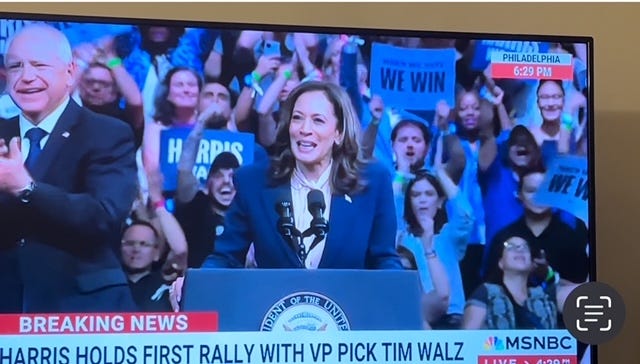
At the Democratic presidential ticket’s raucous unveiling in Philadelphia Tuesday, Kamala Harris nears the end of her speech — and she’s getting better at this — in a sotto voce tone, saying quietly words that need to be said in more bold fashion: “Only in America…only in America…only in America…” Then, something occurred that you don’t often see at Democratic rallies — a spontaneous breaking out of “USA USA USA!”
She smiled, let the moment pass and then finished in the way that she has since her campaign launch two weeks ago at the headquarters-formerly-known-as-Biden-Harris: “Do we believe in freedom? Do we believe in opportunity? Do we believe in the promise of America? Are we willing to fight for it?…And when we fight, we win!”
With the crowd teed up, Tim Walz took the stage and stated an obvious fact: “Some of us are old enough to remember when it was Republicans who were talking about freedom.”
Indeed, historically, the GOP wed that patriotic language to a platform of a party that pushed economic opportunity, lower taxes, fewer regulations and smaller government. But that policy agenda was also attached to a vision statement — the idea of America as a beacon for freedom, Reagan’s classic invocation of the country as a “shining city on a hill.”
The big policy exception on the “freedom” platform, of course, has been abortion where Americans saw Democrats as the pro-choice party (and Walz weaves that notion in, referencing, "turns out they meant the government should be free to invade your doctor’s office”). Nonetheless, partly due to the skepticism of many on the left for overt proclamations of patriotism, Democratic candidates have tended to stay away from the rah-rah FREEDOM bandwagon.
Until now.
Progressives suddenly are going “USA! USA! USA!”
Harris appears ready to pick up and lean into a smart rhetorical affectation borrowed from Barack Obama. After going through his resume, an at-the-time young U.S. senator would add for folks in the back, “In no other country is my story even possible.” In other words, instead of adopting the in-vogue left view that America is a problem, Obama leaned into the notion that America can be a welcoming solution. In that sense, the country served the same way to Kamala Harris’ parents — a place of freedom, opportunity, a place of promise. (Getting Beyonce’s permission to use the anthemic “Freedom” from Lemonade is not a coincidence.)
What makes this timing so perfect is that, under Trump, the GOP has all but abandoned the traditional “freedom” visionary agenda. Trump was never supportive of smaller government or lower spending (look at his four years — including even before the pandemic). Beyond that though, J.D. Vance (yes, the gift that keeps on giving) has dismissed the traditionally conservative patriotic nostrum that “America is an idea.” In the pages of The Atlantic, Jessica Gavora offers a moving testimonial to her immigrant father who escaped Soviet-controlled Czechoslovakia in 1948, and eventually made his way to America where he helped tame what is now modern Alaska.
Gavora uses her father’s stirring story to take issue with J.D. Vance’s critique of America as an inspirational beacon celebrating freedom around the world:
“America is not just an idea,” Vance said in his introductory speech to the American people at the Republican National Convention. Americans won’t fight and sacrifice for “abstractions.” Shared history, he assured us, is what we care about. And shared dirt. He used the morbid image of a cemetery plot in Kentucky coal country, where generations of his family have been laid to rest. He expressed his desire for his children to one day bury him there and—carrying his morbidity to the extreme—for them to eventually follow him.
Gavora’s father — moreso than most — saw what the opposite of the American attraction was. Drawn to the “idea” of America, he sought out the alternative to Soviet oppression.
It wasn’t too dissimilar to what my mother saw more than fifty years ago. Thankfully, she didn’t have to flee Communist oppression. But, even with a nice job as a nurse in England (acquired after an initial move from Trinidad), something in an advertisement in a British paper — a New York hospital seeking nurses — struck a chord with her. Even as a single mother, she believed that an even more expansive life was possible on the other side of the Pond. And she was right. For different reasons, both Vladimir Gavora and Umilta Sallion saw what Harris’ parents saw — opportunity and the promise of America.
Vance’s dismissal of America as an “idea” dovetails, of course, with Donald Trump’s perpetual, in the words of Josh Shapiro, “shit-talking America.” Trump is the one regularly praising dictators and authoritarians — Vladimir Putin, in particular — while dismissing America’s capacity to be a force for good in the world.
In such circumstances, renewing the notion of the American “idea” is a clarion call that the nation regularly needs to hear.
And the timing couldn’t be better.
You’d think that a brand-aware always-be-closing salesman like Donald Trump would realize the importance of refreshing the brand. “MAKE AMERICA GREAT AGAIN,” as strong as it has been is close to a decade old now. Even the best ones need refreshing. That certainly wasn’t evident in his meandering Thursday news conference (unless trying to compete with Rev. Martin Luther King’s March on Washington crowd size is considered a new talking point).
Vance has a point that Americans aren’t drawn to “abstractions.” Harris recognizes that and has largely pushed aside the “abstraction” that Joe Biden had been building his re-election effort on — “democracy.”
As a political issue, it clearly wasn’t resonating. There are likely many reasons for that — not the least of which is that the power of negative partisanship is so strong that MAGA minds here “defend democracy” in a very different way than Democrats and anti-Trump types do. There are two camps that are existentially terrified that this election “will be the last” if the other side wins. Thanks to Trump’s ubiquitous lying about “rigged” elections for nearly a decade, a significant majority of Trump voters still believe the 2020 election was stolen (it wasn’t). Meanwhile, the most recent Supreme Court ruling on presidential immunity leads another significant bloc to think that another Trump win would empower him to try gaming the system even more toward future Republican candidates.
So, “democracy” — the word itself, not just the concept — becomes something too abstract to become a defining talking point on the campaign trail. Surprise — “freedom” is a more concrete abstraction.
Thus, Harris marries her freedom rhetoric with a neophyte platform broad enough to engage directly even with an electorate that might have a rose-colored-glasses view of the Trump presidency. Rather than suggesting those were the good old days, Harris is pushing Trump as the “old” candidate. As an avatar wanting to “take us back,” she suggests that he’d pass a national abortion ban (given that his Supreme Court picks ended Roe, this isn’t a difficult sell for a large segment of the electorate). She says Trump and a Republican Congress would end Obamacare. She uses the handy Project 2025 Heritage playbook to suggest attacks on Social Security and Medicare. She’s doubling down as being the leader of a coalition that stands for representing the rights and policies of the present, rather than going back to an era when those polices and rights were nonexistent.
Like Obama before her, Harris cloaks her progressivism in patriotic cloth, saying in so many words that America is already great. It’s still a beacon that attracts those who revere freedom and going back is move away from greatness already embedded in America.
It’s a bold “ask” that Harris is putting down, but given the stale messaging of the Trump-Vance campaign — a dull rehash of a decade old slogan and the abandoning of the uplifting idea of America — perhaps the left may be on to something here.
I love this rhetoric. But I find it utterly baffling. It is antithetical to her policies. She wants to talk about freedom and also wants me to work for half the year for the government; this is the opposite of freedom. It sounds great but does it actually foreshadow some yet unannounced pivot to economic liberty or are we supposed to not notice the inconsistency?